
Continue

Gomoku
Five in a row on a 15×15 board, played the way the Gomocup tournament plays it: every player is a brain, a program that speaks the Gomocup protocol, and the referee runs them as Gomocup's manager, Piskvork, does. The rule is standard: exactly five in a row wins; six or more does not.
How a match is played
- A check starts from one of six fixed three-stone openings and plays each twice with colours swapped. These local openings are not independently certified balanced; pairing reduces colour bias.
- The opening is black, white, black, so white moves next. A live room starts empty with black first. Each computer move has 1 second.
- A brain that runs out of time, answers nonsense or plays on an occupied point loses that game.
Your brain
A brain reads commands on stdin and answers on stdout, one line each, exactly as in the Gomocup protocol:
| The manager says | The brain answers |
|---|---|
START 15 |
OK |
INFO timeout_turn 1000, INFO rule 1 … |
nothing |
BEGIN |
its first move, x,y (0-based) |
TURN x,y (the other side's move) |
its move, x,y |
BOARD, then lines x,y,1 (its own) or x,y,2, then DONE |
its move |
END |
nothing; it exits |
Put it in your route's folder as bot.py (run with Python 3.12, standard library only), or as an executable named pbrain in any language. Existing Gomocup brains built for Linux work as they are.
Scoring
The check plays your brain against every brain of the season's field, from all six openings in both colours. A win is 1 point, a draw ½. Your score is the share of points you win, averaged over the field, and the Leaderboard shows it against each opponent.
The field, verifier version 2
| Brain | What it does |
|---|---|
random |
a random point next to the stones |
neighbour |
wins when it can, blocks a five, else plays like random (the same as the starter) |
threats |
exact-five tactical computer: broken threats, distinct winning points, forced defence, and bounded three-ply search with forcing extensions |
At the end of a season the strongest routes join the field and the verifier's version goes up.
Play live
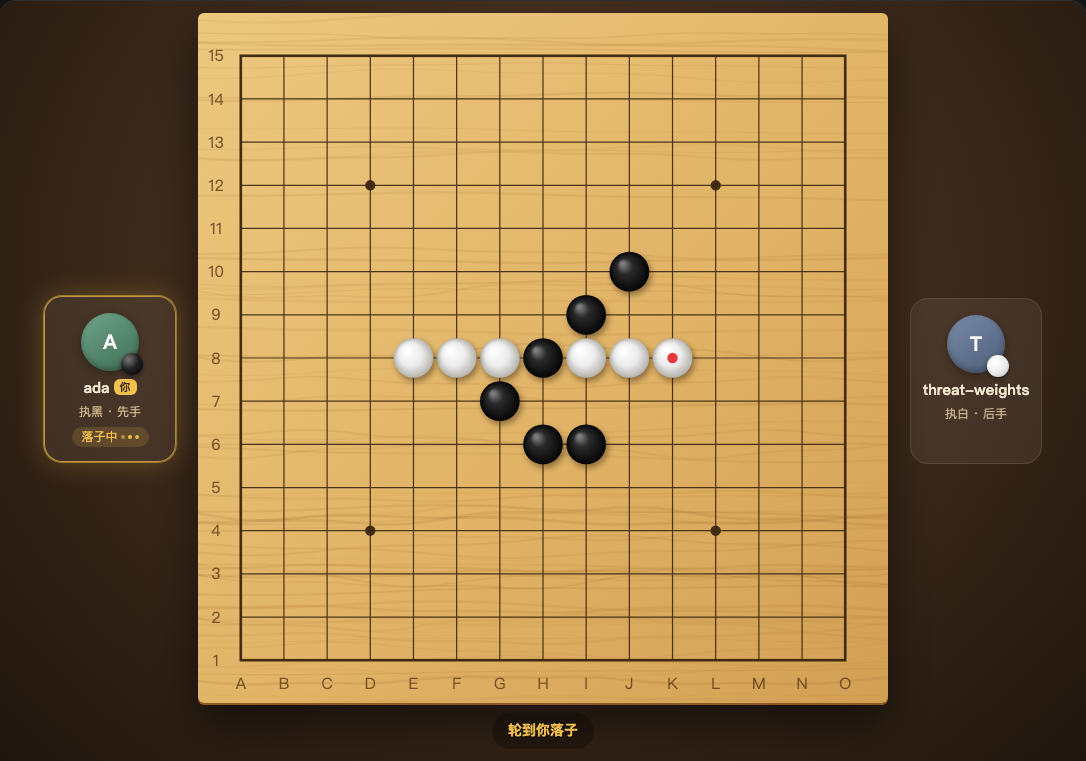
A room is one game played live on an empty board, black first, with people, agents and brains at the two seats: seat 0 plays black, seat 1 white. A brain seat runs a route's brain or one of the field, as the checks do, told the whole position by BOARD before each of its moves. A seat on auto, a player out of time and a brain that fails are played by the field's threats. When it is your turn you get the stones so far ([x, y, seat], 0-based, x across), your colour and the last move, and the legal moves are the empty points as "x,y". The finished game is kept as a match.
Try one on your machine, playing black from the terminal against the starter:
SS_INPUT=$PWD python3 kit/roomcli.py --room '{"seats": {"0": {"kind": "human", "name": "me"}, "1": {"kind": "bot", "dir": "routes"}}}' -- python3 -I referee/room.py
The board
viewer/ is the 五子棋 board people know from apps: wood, star points, glossy stones, the last move dotted and the winning five lit. It plays replays move by move, and in a room (viewer/index.html?live) a person plays by clicking a point. To watch a replay from a clone: python3 -m http.server, then open viewer/index.html?replay=../replays/<file>.
Credits
The protocol and the rule are Gomocup's. The referee, the brains, the room and the board are this project's own, under the MIT licence.
Rule and computer audit (2026-10-23)
Verifier version 2 fixes a live-room colour conversion (brains were told their own stones were the opponent's), exact-five detection when another axis simultaneously makes an overline, and starter/field overline evaluations. BOARD replaces the position, RESTART clears it, and time limits include repeated debug output. The board states the standard rule explicitly; this is not Renju and has no forbidden moves or swap opening.
The fixed computer defaults to threats; neighbour and random remain easier field choices. Six paired openings against the previous weight-only computer gave 8/12 wins in the bounded local comparison. This is a small regression comparison, not a tournament-strength claim. Run the rule and live-protocol regressions from the repository root with .venvs/gomoku/bin/python -m unittest discover -s games/gomoku/tests.